
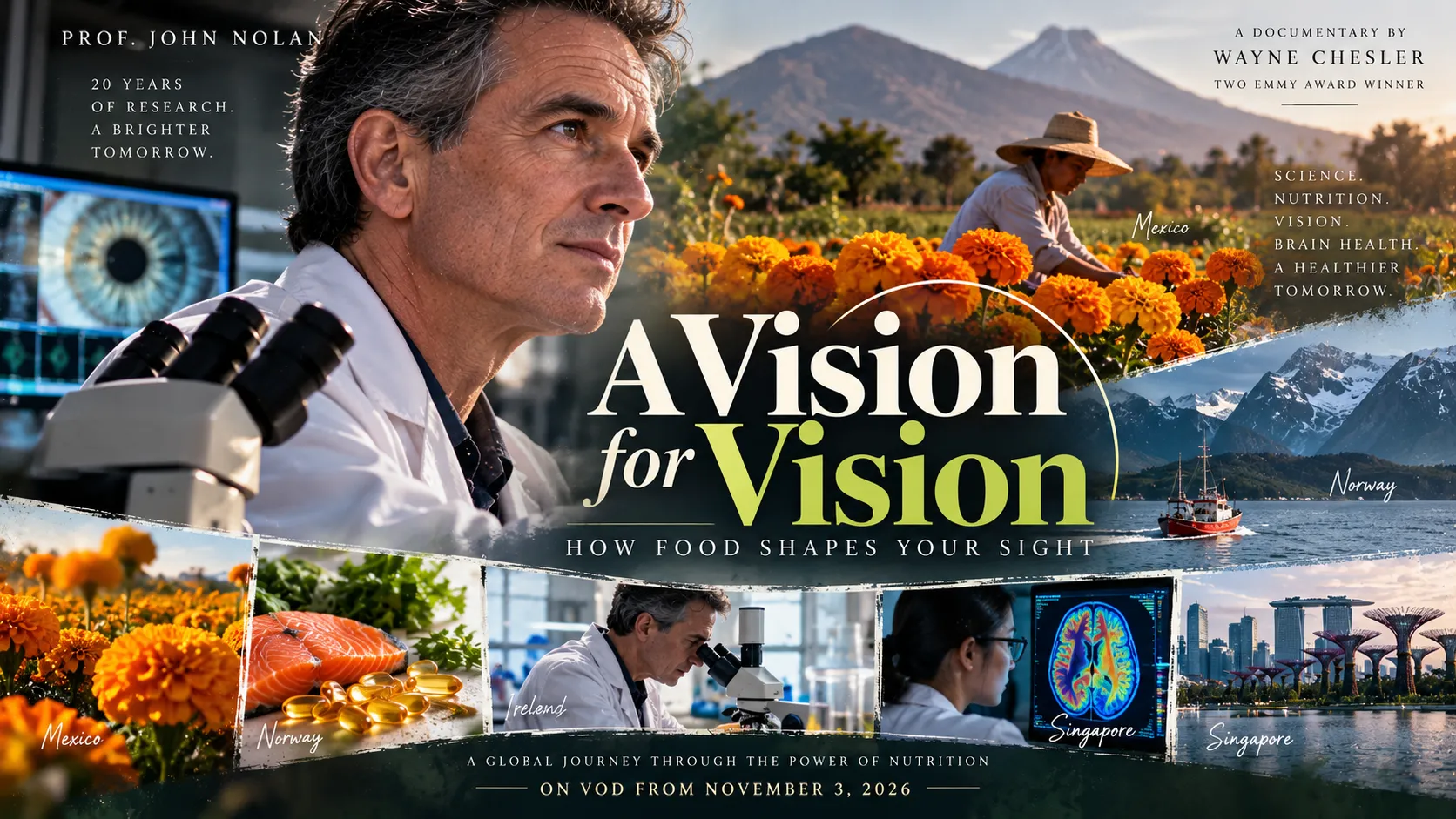
Pikashow | A Vision for Vision: How Food Impacts Your Sight
This documentary explores the relationship between nutrition, eyesight and brain health after 20 years of research led by Prof. John Nolan.
Wayne Chesler, the director and producer of the film, won 2 Emmy awards. With that in mind, we can expect an interesting film, as it explores laboratory research in Ireland, the production of Omega 3 in Norway, the marigold fields of Mexico, and a study in Singapore.
Nutrition is often portrayed in a simplistic manner with diet tips. However, this documentary intends to dig deeper and question how nutrients are linked to vision and brain health and cognition.
There are numerous scientists and researchers featured to explain the evolution of this area of study. (Prof. John Nolan)
Nolan has studied vision for over 20 years
John Nolan is a researcher at South East Technological University in Ireland and is the founder and director of the Nutrition Research Centre Ireland.
His main area of research is macular carotenoids, lutein, zeaxanthin and meso-zeaxanthin and how they impact eye health and human performance.
Nolan and his team have studied how these nutrients impact human health and performance. (Prof. John Nolan)
As the narrative basis of the documentary, Nolan provides the story, and other scientists provided the context of the various studies.
For the audience searching for Pika show, it is essential to know that the documentary A Vision for Vision is a science documentary and not a medical drama.
It is important to point out that the subject of the documentary is a new, evolving area of research and cannot make any claims that a particular food or supplement can prevent all age-related conditions.
The Journey Begins With Plants
One idea presented in the documentary is that there are many compounds produced by plants that could potentially play a major role in human biology.
The film follows that journey.
The documentary captures the various stages of that journey from research in Mexico where marigolds are used to study carotenoids and in Norway where omega-3 are studied. The last leg of the journey is in Ireland where research labs study those compounds.
Going international with the documentary helps to simplify a complex scientific subject.
Instead of using charts or lab terminology, Chesler takes viewers along as the researchers study the compounds that they found in nature and helps viewers see the connection between dietary conditions and the eye.
Vision and the Brain Are Closely Connected
A Vision for Vision gradually covers other areas beyond the eyes.
Professor Nolan's research group is also interested in the connection between nutrition and cognition as well as the brain.
The documentary touches on age related macular degeneration as well as research on memory and cognitive aging. (Prof. John Nolan)
This doesn't mean the film tries to advance the idea that conditions such as dementia can be prevented by nutrition.
The documentary highlights the role that lifestyle and diet play in aging and how, as a researcher, you can study these factors in various populations to determine their role in health maintenance as people age.
Understanding this distinction is critical when analyzing health-related documentaries.
The findings of scientific studies are always evolving. The conclusions of individual studies should not be applied to the general public as medical advice.
The audience of the documentary that is found through searches on platforms like Picashow may view the film as an introduction to an emerging area of study on nutrition and vision.
Wayne Chesler Turns Research Into A Story
Wayne Chesler is the director, writer and producer of the film.
The documentary was filmed over approximately three years, after Chesler and Nolan met through the scientific community. International filming locations included Mexico, Ireland, Norway, Singapore, the UK and the US. (Prof. John Nolan)
Chesler and Nolan aimed to avoid an overtly academic presentation and incorporated elements of travel, research and personal stories to make the presentation more accessible.
Nolan's mother and family become part of the story, as do sporting achievements.
Nolan's personal influence to study the relationship of nutrition and aging came from his mother and was documented in production diaries. (Prof. John Nolan)
The Documentary's Views on Health
The documentary considers health and performance outside of aging.
It mentions the research on elite athletes and their visual and cognitive performance.
Apple TV credits Professor John Nolan, Nur Syahidah Alim, and Leif Kjetil Gjendemsjø among others appearing in the film. (Apple TV)
The broader argument of the film is that understanding the brain and vision is important and relevant at all stages of life, not only the decline of life.
This includes the understanding of how the eye works, what nutrients are naturally present in the retina, and how the researchers measure the changes of visual or cognitive performance.
The documentary poses these questions as part of a continuing scientific process.
What is Confirmed About a Vision for Vision
A Vision for Vision was released in 2026 and is currently listed by Apple TV with a runtime of 46 minutes. Wayne Chesler is credited as director, while Chesler and John Nolan receive writing credits. (Apple TV)
The documentary premiered at Dublin's Light House Cinema in 2026, and has since been shown at other locations as part of promotional activities and special scientific events. (Prof. John Nolan)
Earlier release information pointed to a broader VOD release date of November 3, but since the latest official sources do not always agree on this date, it should not be reported as an established fact.
What is important is the subject of the film.
The movie is based on more than 20 years of research in the field of nutrition, the eye and the brain. It strives to explain complicated research in a way that the average person can understand.
This makes the documentary something other than a typical health-related film. It is more about the evolution of a researcher's mindset and the relationship between food and how we see, think, and age.